
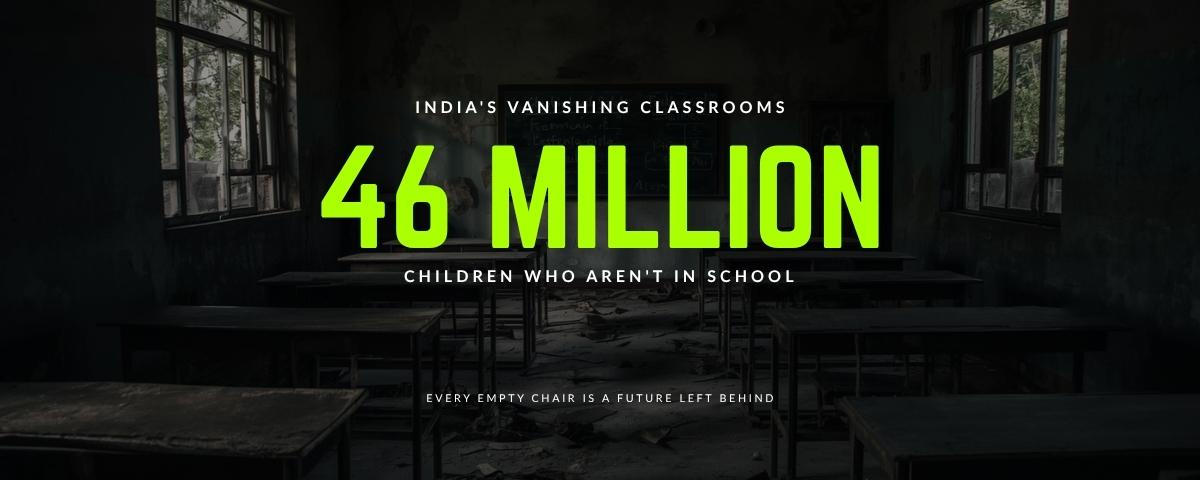
30M+ Orphaned children in IndiaSource: UNICEF India ~700 Registered child care institutions in Gujarat 0…
Out of School Children in Gujarat: The Crisis Behind India’s 46 Million Missing Students
.sp h2{border-left:4px solid #e07b3a;padding-left:10px}
.sp blockquote{border-left:4px solid #e07b3a;background:#f9f8f5;padding:10px 16px;font-style:italic}
.sp table{width:100%;border-collapse:collapse;font-size:14px}
.sp th{background:#0f0c2a;color:#fff;padding:8px 12px;text-align:left}
.sp td{padding:8px 12px;border-bottom:1px solid #eee}
.sp img{max-width:100%;height:auto}
/* Side-by-side layout */
.sp-row {
display: flex;
flex-direction: row;
align-items: flex-start;
gap: 28px;
margin: 36px 0;
}
.sp-row .sp-img-col {
flex: 0 0 42%;
max-width: 42%;
}
.sp-row .sp-img-col img {
width: 100%;
height: auto;
border-radius: 6px;
display: block;
}
.sp-row .sp-img-col figcaption {
margin-top: 8px;
font-size: 13px;
color: #666;
font-style: italic;
}
.sp-row .sp-text-col {
flex: 1;
}
/* Mobile: image stacks above text */
@media (max-width: 680px) {
.sp-row {
flex-direction: column;
}
.sp-row .sp-img-col {
flex: 0 0 100%;
max-width: 100%;
}
}
Education Crisis · Shaksham Foundation
They were enrolled. Their names are on a register. But the desks are empty — and no one is coming.
By Saima Momin, Programme Director, Shaksham Foundation
Published June 2025 · 8 min read · Updated regularly with latest UDISE+ data
A child who drops out of school at 12 will earn roughly 10% less for every year of schooling they lost. That is not an education statistic. It is a lifetime sentence — handed down quietly, in a one-room house in Behrampura or Vatva, while a government register still shows their name as “enrolled.”
India has 46 million of those sentences being issued right now. Not because there are no schools. Not because there are no laws. The Right to Education Act has been in force since 2009. Yet the classrooms keep emptying. Shaksham Foundation works in the communities of Ahmedabad where this dropout crisis is most acute — and this article explains exactly what is happening, why it is getting worse, and what you can do about it.
Key Numbers
- 46 Million — Children aged 6–17 out of school in India (17% of all school-age children). Source: UDISE+ 2024–25, Ministry of Education · Analysis
- 2.4 Lakh — Children Gujarat identified as out of school in 2025–26, the highest of any state. Source: Rajya Sabha Unstarred Question No. 1131, Ministry of Education, 10 Dec 2025
- 29% — Of children drop out before completing elementary education. Source: UNICEF India Education Programme
In This Article
- The scale of the crisis — India, Gujarat, Ahmedabad
- Why this problem is getting worse, not better
- Gujarat in the spotlight: what the 341% increase means
- The human cost: Nandini’s story from Behrampura
- What Shaksham Foundation has done so far
- Why government schemes are not enough
- Why Shaksham Foundation specifically
- What the programme actually delivers
- How your support works — fund breakdown
- How to help — donors, CSR, volunteers
- Frequently asked questions
India’s Out-of-School Children Crisis: From 46 Million to Your Neighbourhood
The UDISE+ 2024–25 data from the Ministry of Education puts the number at 46 million children between ages 6 and 17 who are not in school. This is not 46 million children who never enrolled. Many did. They simply stopped coming — and the system did not follow up.
The dropout problem sharpens at two transition points. First, the move from primary to upper primary school at around age 11. Second, the jump from upper primary to secondary at around age 14. At both points, economic pressure peaks, household responsibilities expand, and schools become harder to reach.
In Gujarat, the picture is sharper still. Parliament data tabled in 2025 shows Gujarat recorded 2.4 lakh out-of-school children in 2025–26 — the highest of any state. Of those, 1.05 lakh are adolescent girls. That represents a 341% increase over the previous year’s figure.
Ahmedabad sits at the centre of this. The city’s rapid growth has drawn hundreds of thousands of migrant families into informal settlements — Behrampura, Vatva, Odhav, Gota — where school access is inconsistent, safety is a concern, and the daily cost of schooling competes with the income a child could earn.
A child who stops attending school at 12 in Behrampura does not get a second chance. In most cases, they never return.
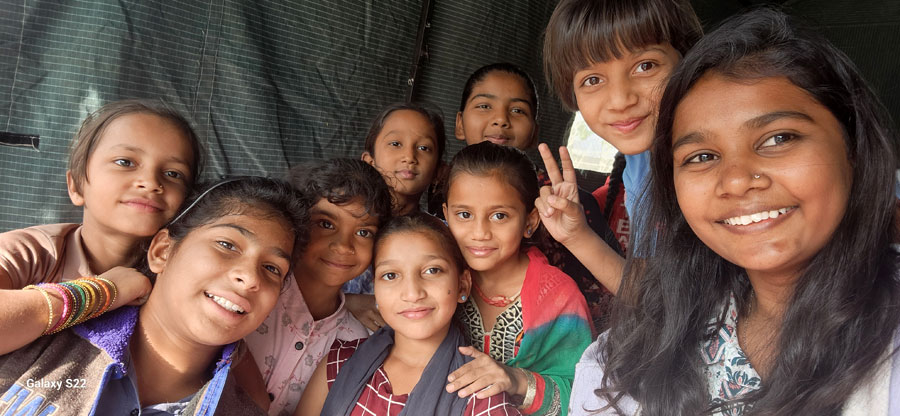
Why India’s School Dropout Problem Is Getting Worse, Not Better
Three structural forces are driving this — and none of them will be solved by an enrolment drive.
1. Government schools are closing, not opening. In Gujarat alone, over 5,000 government schools have been shut down in the last decade. Nationally, 89,441 government schools closed between 2014–15 and 2023–24. When the nearest school is 5–6 km away, families — especially those with daughters — stop sending their children.
2. Economic pressure hits hardest at transition ages. The UNICEF India Education Programme identifies migration, domestic responsibilities, and child labour as the top reasons for dropout. A family on ₹8,000 per month cannot afford to have an able-bodied child sitting in school. That is not apathy. That is arithmetic.
3. Learning quality has collapsed, reducing the incentive to stay. UNICEF’s 2024 Annual Report on India documents a fall in Class 8 mathematics proficiency from 40% to 27% between 2017 and 2021. When children attend school and still cannot calculate, parents stop seeing the point.
These three forces feed each other. Fewer schools mean longer distances. Longer distances mean girls drop out. Girls who drop out become mothers who cannot advocate for their own children’s education. The cycle is not a metaphor. It is generational.
Gujarat in the Spotlight: Understanding the 341% Surge in Out-of-School Children
When Gujarat topped India’s out-of-school children rankings in 2025, the number that drew the most attention was not the total count — it was the rate of increase. A 341% rise in one year does not happen because more children are dropping out. It happens because a system that was previously hiding the numbers has been forced to count them more honestly.
That distinction matters. Gujarat is not necessarily worse than other states. It may simply be the first state to conduct a thorough enough survey to surface the scale of a crisis that exists everywhere. The 2.4 lakh figure is almost certainly an undercount — children in unregistered settlements, seasonal migrant families who move before the survey date, and children employed in brick kilns or textile units are unlikely to appear in any official register.
The gender dimension is especially stark. Of Gujarat’s 2.4 lakh out-of-school children, 1.05 lakh — roughly 44% — are adolescent girls. In the neighbourhoods where Shaksham Foundation works, the most common pathway for a girl who drops out at 13 is not further education or vocational training. It is early marriage.
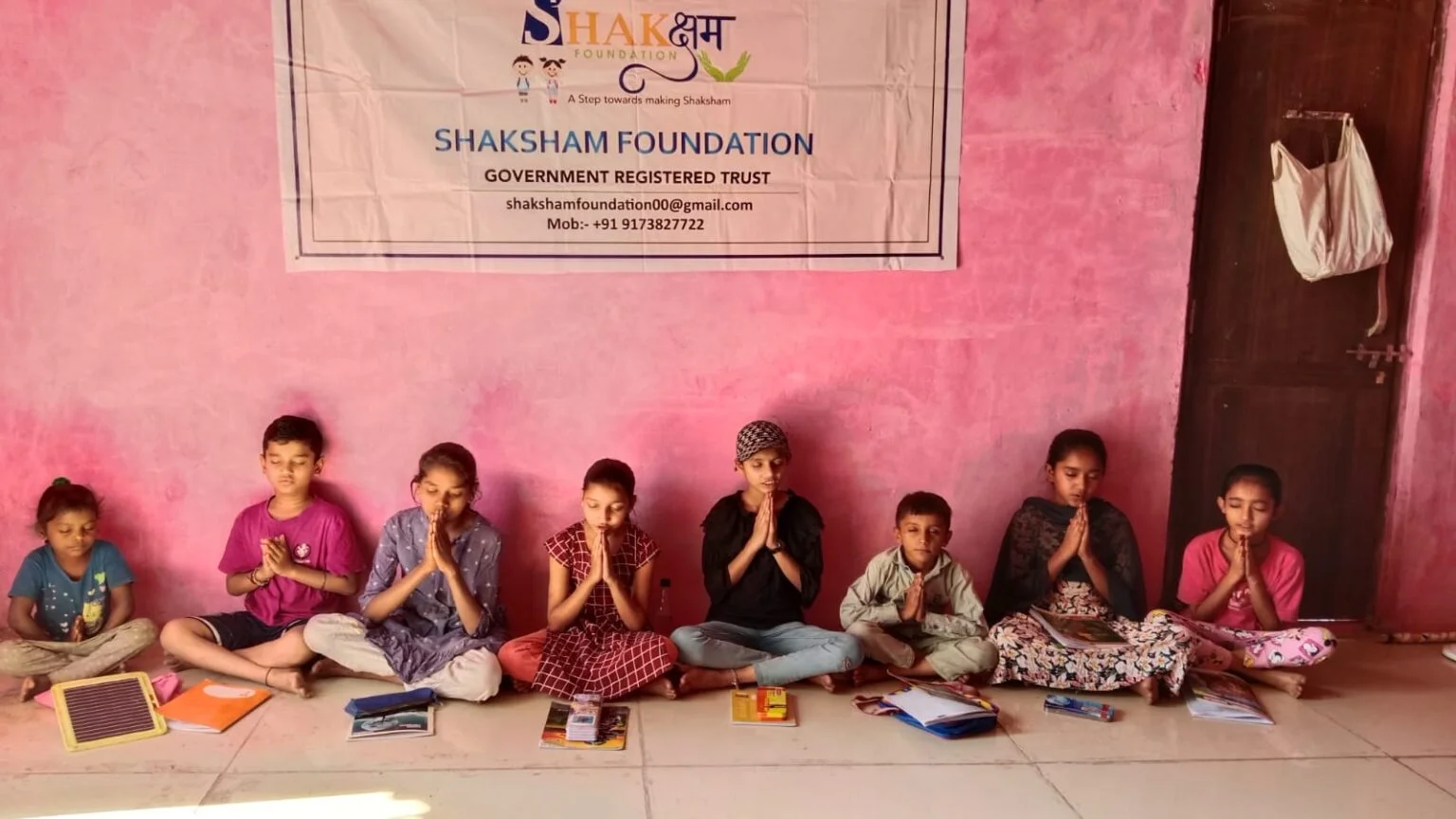
The Ahmedabad-specific picture is shaped by its particular urban geography. Unlike small towns where dropout is driven primarily by distance, Ahmedabad’s dropout crisis is concentrated in areas that are physically close to schools but structurally excluded from them. Families who moved from Rajasthan, Uttar Pradesh, or Madhya Pradesh may not have birth certificates or ration cards with Ahmedabad addresses. The school may be 200 metres away. The documentation barrier makes it functionally unreachable.
This is why the informal settlement — not the distant village — is the frontline of the dropout crisis in urban Gujarat. And this is precisely why Shaksham Foundation’s approach, built on neighbourhood-level presence and case-by-case documentation support, is the intervention that makes the difference.
The Human Cost: What This Looks Like on One Street in Behrampura
When Shaksham Foundation’s outreach team first met Nandini — not her real name — in 2022, she was sorting used plastic bottles on the floor of her one-room home in Behrampura, Ahmedabad. Her hands moved fast. She had been doing this since 6 a.m. It was 9:15 a.m. School had started forty-five minutes ago.
Nandini was 13. She had studied up to Class 5. When her father’s construction work dried up during the monsoon and her mother fell ill, Nandini became the household’s second earner. There was no one to object and no system to notice. Her name stayed in the school register for two more terms.
After Shaksham enrolled her in a remedial bridge course, Nandini resumed formal education — without repeating lost grades and without the shame of being placed with younger children. Within 14 months she had passed the Class 7 assessment and was admitted to Class 8 at a government secondary school near her home.
In Shaksham’s field experience, the critical window is the first 12 to 18 months after a child stops attending. After that, re-enrolment rates drop sharply.
What Shaksham Foundation Has Done So Far
All figures below are drawn from Shaksham Foundation’s internal programme records and Annual Report.
- 1,200+ children and youth directly reached through education and livelihood programmes — verified in our Annual Report
- 7+ years of continuous operation in Ahmedabad’s most underserved communities — registered since 2017, Reg. No. F/21847/Ahmedabad
- 80G certified — all donations eligible for income tax deduction under Section 80G
“I thought my daughter’s school days were finished. Shaksham’s team came to our home three times before we agreed. Now she is in Class 9. I did not think this was possible.”
— Father of a beneficiary, Vatva, Ahmedabad (name withheld on request)

Why Government Schemes Are Not Solving India’s School Dropout Crisis
India is not short on policy. The Samagra Shiksha scheme allocates roughly ₹56,000 crore per year to education. The Mid-Day Meal programme reaches crores of children daily. The RTE Act guarantees free schooling up to age 14.
And still: 46 million children are not in school.
The gap is not funding — it is implementation. Government surveys identify out-of-school children once a year, in bulk. By the time a child is flagged, six months of learning have already been lost. The re-enrolment mechanisms — bridge courses, open schooling — exist on paper. But the on-ground, door-to-door case management that actually brings a child back to a desk does not exist at scale.
There is also the problem of documentation. Government school admission requires proof of age, proof of address, and transfer certificates from the previous school. A child who moved from Rajasthan three years ago, whose family has been living in an informal settlement without a formal lease, may not have a single qualifying document. This is a solvable problem — but only for an organisation with the time, relationships, and community knowledge to solve it case by case.
That gap — between the child who is identified and the child who is back in a classroom — is exactly where Shaksham Foundation works.
Why Shaksham Foundation Is the Right Organisation for This Work
Legal standing: Registered under the Societies Registration Act — Reg. No. F/21847/Ahmedabad — with both 80G and 12A certifications from the Income Tax Department.
Hyperlocal presence: Outreach workers are often residents of the same communities they serve. Dropout re-enrolment requires trust, repeated visits, and real-time knowledge of which family is in crisis today.
Integrated approach: Children are out of school for economic reasons. Shaksham addresses nutritional support, livelihood training for parents, and school re-entry together. This is what turns a one-time enrolment into sustained attendance.
Transparent fund use: Every rupee is tracked against a specific programme output. Programme data and fund-use details are available on request.
Focus on sustained attendance: Shaksham measures success by children still attending 12 months after re-enrolment — not by enrolment counts alone.
What Shaksham Foundation’s Education Programme Actually Delivers
- School Re-Entry: Out-of-school children identified through door-to-door surveys and returned to formal schooling via a 4–6 month bridge learning course.
- 12-Month Attendance Tracking: Monthly home visits for 12 months after re-entry to confirm continued attendance and catch new household crises early.
- Nutritional Support: Supplemental nutrition directly removes the cost that most often triggers dropout decisions.
- Parent Livelihood Linkages: Parents connected to vocational training and income-generation programmes, reducing the economic pressure that caused the dropout.
- Adolescent Girls’ Safety Programme: Dedicated programme addressing early marriage pressure, unsafe travel, and menstrual hygiene barriers.
- Documentation Assistance: Shaksham’s team works with local government offices to secure the documents families need for school admission.
How Your Donation Works — Transparent Fund Allocation
| Where Your Money Goes | % |
|---|---|
| Direct Programme Costs | 72% |
| Field Staff and Outreach | 14% |
| Monitoring, Data and Reporting | 8% |
| Administration and Overheads | 6% |
What specific amounts do:
- ₹500 — Nutritional support for one child for one full month.
- ₹2,000 — A complete bridge learning kit for one child for one term.
- ₹12,000 — Full annual cost of re-enrolling, tracking, and supporting one out-of-school child.
80G Tax Benefit: All donations are eligible for 50% income tax deduction under Section 80G of the Income Tax Act, 1961. Your certificate is issued within 7 working days.
How to Help — For Donors, Companies, Volunteers, and More
Individual Donors: A one-time donation of ₹500 or a monthly commitment of ₹200 makes a direct, traceable difference. Both are 80G eligible.
→ Donate at shakshamfoundation.org/donate-now/
Corporate CSR Partners: Programmes qualify under Schedule VII, clauses (ii) and (iii) of the Companies Act, 2013.
Email info@shakshamfoundation.org — Subject: “CSR Enquiry” · Call +91 9173 82 7722
In-Kind Donors: Currently needed: school bags, stationery, Class 5–10 textbooks, functional tablets or computers.
Email info@shakshamfoundation.org — Subject: “In-Kind Donation”
Volunteers: Remedial teaching in English, Maths, or Hindi. Minimum 4 hours/week. Remote tutoring available. See volunteer roles →
WhatsApp: +91 9173 82 7722
Just Want to Share This? Forward this article to one person who runs a company, teaches, or cares about education in India.
₹500 is all it takes to keep one child fed and in school for a full month.
That child’s name is on a register. Their attendance is tracked. You will know exactly what happened to your money.
→ Donate Now at shakshamfoundation.org/donate-now/
Frequently Asked Questions
Is Shaksham Foundation a legitimate registered NGO?
Yes. Shaksham Foundation is registered under the Societies Registration Act with Registration No. F/21847/Ahmedabad. It holds both 80G and 12A certifications from the Income Tax Department. You can request verification documents at info@shakshamfoundation.org.
Will I get an 80G tax certificate for my donation?
Yes. Shaksham is 80G certified under the Income Tax Act, 1961. You are eligible for a 50% deduction on your taxable income. An 80G receipt is issued within 7 working days.
How does Shaksham Foundation bring out-of-school children back to school?
The process starts with community surveys that identify out-of-school children by name and address. Outreach workers make home visits — usually two to three visits before a family agrees to engage — to understand why the child dropped out. Children complete a 4–6 month bridge learning course and are re-admitted at the appropriate grade. Monthly follow-up visits continue for 12 months after re-admission.
Where exactly does Shaksham Foundation work in Ahmedabad?
Shaksham primarily operates in the informal settlements of Ahmedabad including Behrampura, Vatva, Odhav, and Gota. These areas have high concentrations of migrant families and among the highest school dropout rates in the city.
Can my company fund Shaksham Foundation through CSR?
Yes. Shaksham’s programmes are eligible under Schedule VII, clauses (ii) and (iii) of the Companies Act, 2013. We provide a detailed programme proposal, quarterly impact reports, and all documentation required for CSR compliance filing. Email info@shakshamfoundation.org with “CSR Enquiry” in the subject line.
Why does India have 46 million out-of-school children when the RTE Act guarantees free education?
The Right to Education Act guarantees legal access. Physical, economic, and social access are different things. Government schools have been closing — 89,441 shut down nationally between 2014 and 2024. Children in informal settlements move frequently and lose school paperwork. Girls face safety concerns walking long distances. Families in poverty need children to earn or care for siblings.
Why is Gujarat ranked first in India for out-of-school children?
Gujarat recorded 2.4 lakh out-of-school children in 2025–26 — the highest of any state, representing a 341% increase over the previous year. This likely reflects both a genuine rise in dropout numbers and improved survey methodology. Urban informal settlements in Ahmedabad, Surat, and Vadodara contribute disproportionately, particularly among migrant families without local documentation.
How do I volunteer with Shaksham Foundation?
Shaksham accepts volunteers for remedial teaching in English, Maths, or Hindi. The minimum commitment is 4 hours per week for at least 3 months. Send your name, location, availability, and skills to info@shakshamfoundation.org or WhatsApp +91 9173 82 7722.
Help This Research Reach More People
This article is freely available to journalists, educators, researchers, and NGOs. If you reference the data or arguments here, please link back to this page.
Suggested citation:
Saima Momin, “Out of School Children in Gujarat: The Crisis Behind India’s 46 Million Missing Students,” Shaksham Foundation, June 2025. Available at: https://shakshamfoundation.org/blog/out-of-school-children-gujarat/
For more on Shaksham Foundation’s work, visit our Programmes page, read our Annual Report, or learn About the organisation.
About the Author
Saima Momin, Programme Director, Shaksham Foundation
Saima Momin has worked in community education and child welfare in Ahmedabad for over 7 years, with a focus on school dropout prevention in urban informal settlements. At Shaksham Foundation, she oversees field programmes across Behrampura, Vatva, Odhav, and Gota.
Shaksham Foundation · Reg No. F/21847/Ahmedabad · 80G & 12A Certified
info@shakshamfoundation.org ·
+91 9173 82 7722 ·
shakshamfoundation.org

Related Posts
Comments (0)