
Social Issues · Child Welfare · Gujarat Help Us Build an Orphanage in Gujarat Help…
The Hidden Hunger Crisis in India: Why Indian Children Are Starving in a Land of Plenty
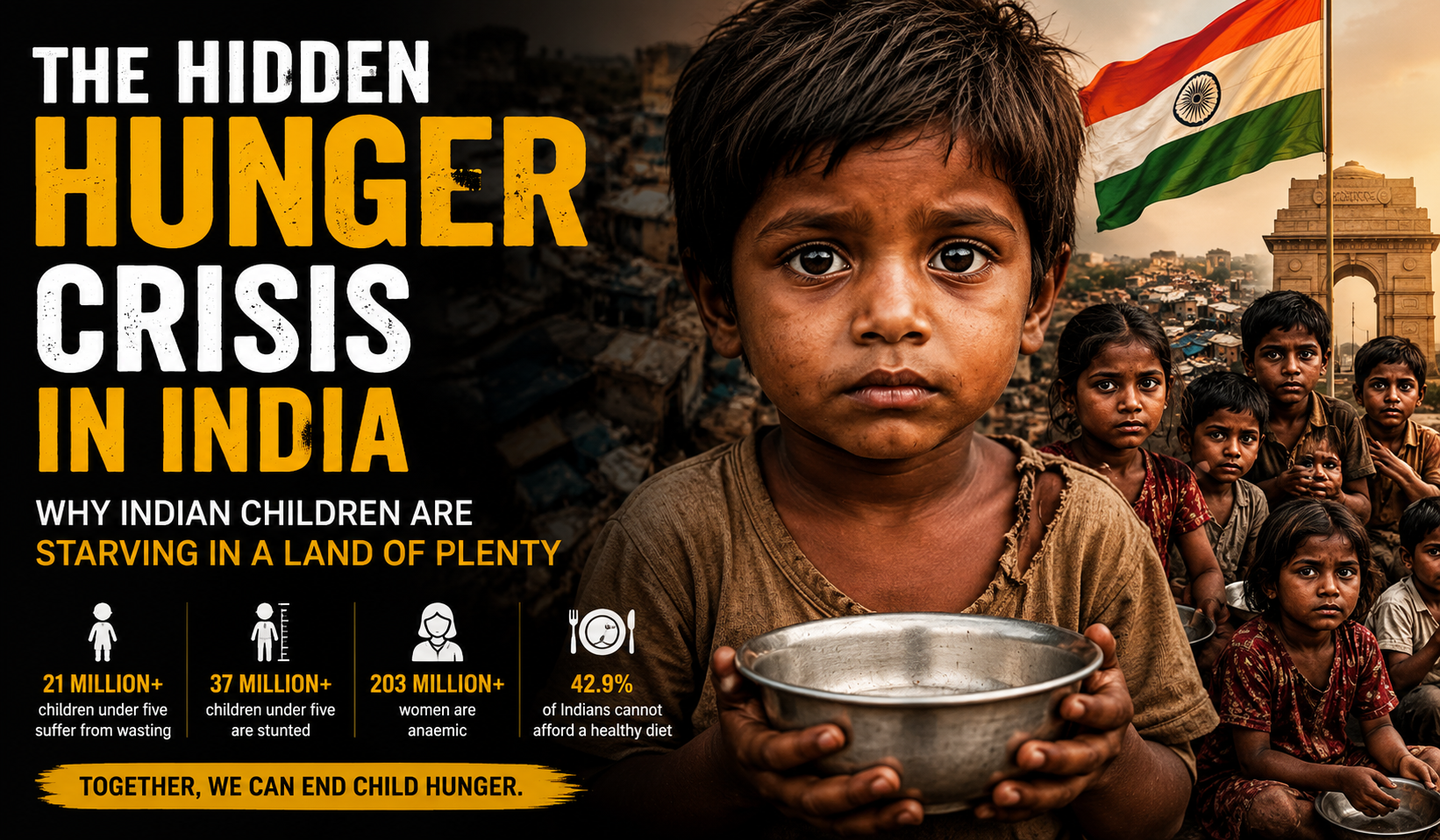
India grows enough food to feed itself and export the surplus. Yet it is home to the highest rate of child wasting on Earth. That contradiction — abundance on paper, hunger on the ground — is one of the most urgent and least discussed emergencies in the country today.
The numbers that should alarm everyone
According to the United Nations’ 2025 State of Food Security and Nutrition in the World report, 18.7% of Indian children under five suffered from wasting in 2024 — the highest rate of any country in the world. That translates to more than 21 million children with dangerously low weight for their height, a condition usually caused by too little food, the wrong kind of food, or repeated illness.
Wasting is the acute crisis. Stunting is the slow, generational one. An estimated 37 million Indian children under five are stunted — permanently shorter than they should be, with the long-term cognitive and immune damage that comes with it. Nationally, the Composite Index of Anthropometric Failure, which tracks children who are stunted, wasted, or underweight, stood at 41% in 2025. It is improving — it was 52.6% in 2021 — but “improving” still means four in ten children are failing to grow as they should.
The crisis isn’t confined to children. Over half of Indian women aged 15-49 — 203 million women — are anaemic. A malnourished mother is far more likely to have a malnourished child, which means this is not one crisis but a cycle repeating itself across generations.
Why this keeps happening
Nearly 45% of all deaths among children under five in India are linked to undernutrition, not as the headline cause, but as the underlying weakness that lets a common infection turn fatal. Despite India’s economic growth, an estimated 42.9% of Indians still cannot afford a healthy diet, and 12% remain undernourished outright.
The crisis is sharply uneven. State-level data for 2025 shows Jharkhand at 54.5% child malnutrition, Bihar at 53.0%, Uttar Pradesh at 52.0%, Madhya Pradesh at 51.0%, and Gujarat at 50.5% — compared to Kerala’s 35.5%. Poverty, low maternal literacy, and weak access to healthcare consistently track together: where mothers cannot read a nutrition label or afford a balanced diet, their children pay the price first.
There’s a second, stranger layer to this story. India is now also facing a rising tide of childhood obesity — UNICEF’s 2025 Child Nutrition Report found that 9.4% of children aged 5-19 are now classified as overweight or obese, even as undernutrition persists. India is fighting hunger and excess at the same time, in the same generation, often in the same neighbourhoods.
Frequently Asked Questions
What actually changes this
The evidence is consistent: the first 1,000 days of a child’s life — from conception to age two — determine almost everything. Consistent, nutrient-dense meals during this window, paired with basic maternal health support, can interrupt the cycle before it starts. This isn’t a mystery to solve; it’s a logistics and funding problem to close.
At Shaksham Foundation, this is precisely where our work begins. We provide nutritious daily meals to the children in our care, ensure every child at our free schools in Behrampura and Thaltej is properly fed and not just educated, and channel surplus food from events across Ahmedabad to families who need it through our Leftover Food Donation programme rather than letting it go to waste. Hunger that has a face and an address is hunger that can be solved.
A starving child does not experience statistics. They experience a missed meal, a stomach that hurts at school, a body that stops growing on schedule. The numbers above are not abstractions — they describe real children in Gujarat, in Bihar, in every state in this country, right now.
You can change one of those numbers today. Support our Medical Support programme to help fund nutrition and health interventions for vulnerable children, or contribute to our Leftover Food Donation initiative to turn surplus into sustenance. Donate now — every rupee moves a child further from the wrong side of these statistics.

Related Posts
Comments (0)