

Scholarships for Students in India: Government Schemes, Eligibility and How to Apply
Education can open doors to better career opportunities, but the cost of studying is a major concern for many families. School fees, college tuition, books, accommodation and other academic expenses can make it difficult for students to continue their education. This is where scholarships for students in India can make a real difference.
Scholarships provide financial assistance to eligible students so they can continue their studies without carrying the full financial burden. Depending on the scheme, support may be available for school education, undergraduate courses, postgraduate studies, technical education and professional programmes.
The Government of India, state governments, educational institutions and private organisations offer different scholarship opportunities. However, each programme has its own eligibility conditions, application process and deadlines. Understanding these details before applying can help students find suitable financial support.
Organisations such as Shaksham Foundation also work in areas of social welfare and education support. Its Education Support programme focuses on helping children who face barriers to continuing their education.
ton to change this text. Lorem ipsum dolor sit amet, consectetur adipiscing elit. Ut elit tellus, luctus nec ullamcorper mattis, pulvinar dapibus leo.
What Are Scholarships for Students in India?
Scholarships are financial awards given to eligible students to support their education. Unlike regular education loans, scholarships generally do not require repayment, provided the student follows the conditions of the particular scheme.
Some scholarships reward academic performance, while others provide assistance based on family income, social category, disability or other eligibility requirements. Certain programmes also support students pursuing specific courses or studying in particular regions.
For example, a student from a financially weaker family may qualify for an income-based scholarship, while a student with strong academic results may be eligible for a merit-based award. The amount and benefits depend on the scheme.
The National Scholarship Portal (NSP) is an official government platform where students can explore available central and other participating scholarship schemes, check eligibility and submit applications.
Why Are Scholarships Important for Students?
Financial difficulties should not become an unnecessary barrier to education. Scholarships help eligible students manage academic expenses and continue studying when paying the full cost becomes difficult.
Here are some of the main benefits of educational scholarships:
- Reduced education expenses: Financial assistance can help cover eligible tuition fees and other academic costs.
- Better access to education: Students from financially weaker families can explore opportunities to continue their studies.
- Support for academic performance: Merit-based scholarships recognise students who achieve strong academic results.
- Help with higher education: Eligible students can find financial support for college, university and professional courses.
- Greater educational continuity: Financial assistance can help reduce the risk of students leaving their studies because of financial pressure.
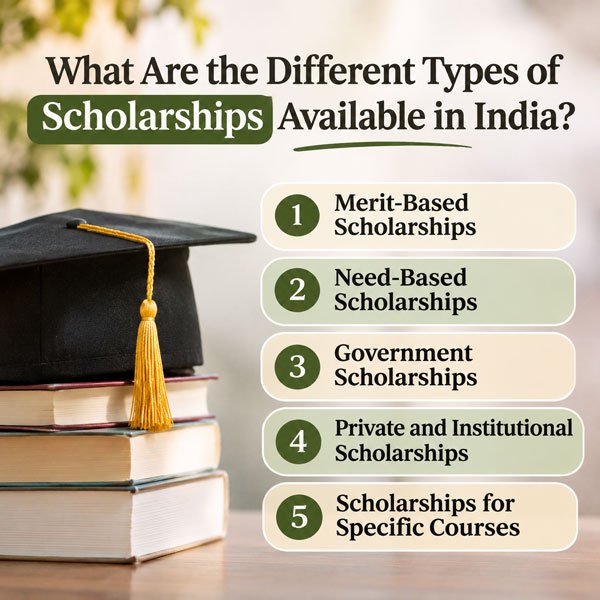
What Are the Different Types of Scholarships Available in India?
Scholarships in India are offered under different categories. Knowing how these categories work makes it easier to identify programmes that match a student’s academic background and financial circumstances.
1. Merit-Based Scholarships
Merit-based scholarships are awarded to students who meet specific academic performance requirements. Selection may depend on examination marks, entrance test results or other academic achievements.
These scholarships encourage students to maintain good academic performance and can provide financial assistance for further studies.
2. Need-Based Scholarships
Need-based scholarships focus on students whose families face financial difficulties. Eligibility usually depends on family income and other conditions mentioned in the scheme guidelines.
These programmes aim to make education more affordable for students who may struggle to pay tuition fees and related expenses.
3. Government Scholarships
Central and state governments offer scholarships for eligible students at different stages of education. These schemes may be designed for specific income groups, social categories, academic levels or educational courses.
Students should check the official National Scholarship Portal scheme list to review available programmes, eligibility conditions and application dates.
4. Private and Institutional Scholarships
Private companies, charitable foundations, universities and educational institutions also provide scholarships. Some focus on academic achievement, while others support students who need financial assistance or plan to pursue particular fields of study.
Application requirements differ between organisations, so students should always read the official guidelines before submitting an application.
5. Scholarships for Specific Courses
Some scholarships are designed for students studying technical, professional or specialised subjects. These may include engineering, medical education, research, postgraduate studies and other recognised courses.
Course-specific scholarships can help eligible students manage education expenses while pursuing their chosen academic path.
Which Government Scholarships Are Available for Students in India?
The Government of India offers several scholarship programmes for school students, college students and those pursuing technical or professional courses. Each scheme has specific eligibility conditions, such as academic performance, family income, social category, disability status or course of study.
Here are some important government scholarship schemes worth exploring.
1. National Means-cum-Merit Scholarship Scheme (NMMS)
The National Means-cum-Merit Scholarship Scheme supports eligible students from economically weaker families who are studying in government, government-aided and local body schools. It aims to help deserving students continue their education after the elementary level.
Selection is based on the prescribed examination and eligibility requirements. Students should check the latest guidelines issued by the education department and the official scholarship portal before applying.
2. PM-USP Central Sector Scheme of Scholarship for College and University Students
The PM-USP Central Sector Scheme of Scholarship for College and University Students provides financial assistance to eligible students pursuing higher education. Academic performance in Class 12 and family income are among the important conditions considered under the scheme.
Applicants must meet the prescribed academic and income requirements and study in an eligible recognised institution. Renewal students must also satisfy the scheme’s continuation conditions.
Fresh and renewal applications are handled through the National Scholarship Portal. The application window and requirements should be checked for the relevant academic year.
3. AICTE Pragati Scholarship Scheme
The AICTE Pragati Scholarship Scheme is designed to support eligible girl students pursuing approved technical education programmes. It covers eligible students enrolled in technical diploma and degree courses at institutions approved under the scheme.
Admission requirements, the number of available scholarships and other conditions are specified in the official guidelines. Students should confirm that their institution and course meet the requirements before applying.
Further information is available through the All India Council for Technical Education (AICTE) and the National Scholarship Portal.
4. AICTE Saksham Scholarship Scheme
The AICTE Saksham Scholarship Scheme provides educational support to eligible specially abled students pursuing approved technical diploma or degree programmes.
Applicants must meet the disability-related, admission and institutional requirements mentioned in the current scheme guidelines. The scholarship aims to reduce financial barriers for eligible students pursuing technical education.
Students can review the current application details on the official list of National Scholarship Portal schemes.
5. PM YASASVI Scholarship Scheme
PM YASASVI includes scholarship support for eligible students belonging to Other Backward Classes (OBC), Economically Backward Classes (EBC) and De-Notified, Nomadic and Semi-Nomadic Tribes (DNT). Its education support includes separate schemes for school-level and college-level studies.
Eligibility depends on the student’s category, family income, educational level, institution and other conditions specified in the scheme guidelines. Applicants should check the relevant school or college scheme rather than assuming that the same rules apply to both.
The National Scholarship Portal scheme directory provides the latest available details.
6. Post-Matric Scholarships for SC and ST Students
Post-matric scholarships provide financial assistance to eligible students from Scheduled Caste (SC) and Scheduled Tribe (ST) communities studying after Class 10. Depending on the scheme, support may cover approved tuition fees, maintenance allowances and other eligible academic expenses.
These scholarships are governed by specific income limits, course requirements, documentation rules and application procedures. Some programmes are administered by state governments, while others follow central government guidelines.
Students should check the relevant state scholarship department and the National Scholarship Portal for current application information.
Which Scholarships Are Available for Students in Gujarat?
Students living in Gujarat can explore state government scholarships in addition to central government programmes. These schemes support eligible students from different communities and income groups at school, college and professional education levels.
The Digital Gujarat Portal provides access to several state government services, including scholarship applications. Available schemes and application periods depend on the academic year and the student’s eligibility.
Some scholarship options available through Gujarat government departments include:
- Post-Matric Scholarships: Financial assistance for eligible SC, ST and other specified category students pursuing education after Class 10.
- Mukhyamantri Yuva Swavalamban Yojana (MYSY): Financial assistance for eligible students pursuing higher education, subject to the scheme’s academic, income and admission requirements.
- Merit-cum-Means Scholarships: Support for eligible students based on academic performance and financial circumstances under specific schemes.
- Higher Education Assistance: Selected state schemes provide support for eligible students enrolled in recognised higher education courses.
- Professional Course Assistance: Certain programmes provide financial help for eligible students pursuing medical, engineering, diploma and other professional courses.
Students can also review the official MYSY portal for scheme information and application updates. The eligibility criteria and required documents should be checked carefully before submitting an application.

How to Choose the Right Scholarship?
Finding a suitable scholarship requires more than searching for financial assistance. A student must match the scheme’s requirements with the current course, academic record, family income and other applicable conditions.
Before applying, check these important points:
- Education level: Confirm whether the scholarship supports school, undergraduate, postgraduate or professional studies.
- Academic requirements: Review the minimum marks, examination results or other performance conditions.
- Family income: Check whether the scheme has an annual household income limit.
- Category requirements: Some schemes are available only to students belonging to specified social categories.
- Institution approval: Confirm that the school, college or university is recognised and eligible under the scheme.
- Application deadline: Check the latest submission date and complete the application within the announced period.
Applying for a scholarship without checking its conditions can lead to rejection or delays. Careful verification helps students focus on programmes that match their circumstances.
How to Apply for Scholarships for Students in India?
Most government scholarships accept applications through official online portals. Students should follow the instructions carefully because incomplete forms, incorrect details or missing documents can affect the application.
Step 1: Find a Suitable Scholarship
Start by identifying scholarships that match the student’s education level, academic performance, family income and other eligibility conditions.
For central government schemes, visit the National Scholarship Portal scheme directory. Students in Gujarat can also check the Digital Gujarat Portal for state scholarship services.
Step 2: Read the Eligibility Guidelines
Before starting the application, read the official scheme guidelines. Check the minimum marks, annual family income limit, eligible course, institution requirements and any category-specific conditions.
Also confirm whether the scheme accepts fresh applications, renewal applications or both. This step helps students avoid applying for a scholarship that does not match their circumstances.
Step 3: Complete One Time Registration on NSP
The National Scholarship Portal requires One Time Registration (OTR) for scholarship applications hosted on the portal. OTR provides a unique 14-digit identification number linked to the student’s Aadhaar or Aadhaar Enrolment ID, as applicable under the registration guidelines.
To complete the process, students generally need an active mobile number and must follow the portal’s identity verification instructions. After registration, the OTR number is used to access the scholarship application process.
Remember that generating an OTR does not mean a scholarship application has been submitted. The student must still complete and submit the relevant scheme application.
For registration instructions, visit the official National Scholarship Portal student section.
Step 4: Fill in the Scholarship Application Form
Log in to the relevant portal and select the scholarship scheme that matches the student’s eligibility. Enter the requested personal, academic, bank and institution details carefully.
Make sure the information matches the supporting documents. Differences in the student’s name, date of birth, bank details or academic records can create verification problems.
Step 5: Upload the Required Documents
Upload clear and readable copies of the documents requested by the scholarship provider. Follow the specified file format and size limits.
Before uploading, check that each document belongs to the correct student and contains accurate information. Do not submit altered or misleading documents.
Step 6: Review and Submit the Application
Review every section before submitting the form. Check the spelling of names, academic details, income information, bank account details and uploaded documents.
After submission, save the application reference number or acknowledgement receipt. It can help when checking the application status or contacting the relevant department.
Step 7: Complete Verification and Track the Application
After submission, the application may go through verification by the educational institution and the concerned government department. Some schemes require additional checks before approval.
Students should regularly check the application status on the official portal. If the department requests corrections or additional information, follow the instructions within the permitted time.
For eligible National Scholarship Portal payments, students can also use the official Public Financial Management System (PFMS) to check payment-related information.
What Documents Are Required for Scholarship Applications?
Document requirements vary according to the scholarship scheme, education level and applicant category. However, many applications ask for some common records.
- Aadhaar Card: Used for identity verification where required by the scheme.
- Recent Passport-Size Photograph: A clear photograph in the format specified by the portal.
- Previous Academic Marksheet: Proof of the student’s previous examination results.
- Income Certificate: Evidence of the family’s annual income, where applicable.
- Caste or Category Certificate: Required for schemes that provide support to specific eligible categories.
- Bank Account Details: Bank passbook or other accepted proof of the student’s account.
- Admission or Bonafide Certificate: Confirmation of enrolment from the school, college or institution.
- Fee Receipt: Proof of education fees paid, if requested.
- Domicile Certificate: Required for certain state government scholarships.
- Disability Certificate or UDID: Required for relevant scholarships supporting eligible students with disabilities.
Not every scholarship requires all these documents. The official scheme guidelines should be treated as the final checklist.
Common Mistakes to Avoid When Applying for Scholarships
Even eligible students can face application delays if they make avoidable mistakes. Careful preparation can help reduce these problems.
- Choosing the wrong scheme: Always confirm that the scholarship matches the student’s course and eligibility.
- Entering incorrect details: Make sure personal and academic information matches the official records.
- Uploading unclear documents: Submit readable documents in the accepted file format.
- Missing application deadlines: Check the opening and closing dates for the selected scheme.
- Ignoring renewal requirements: Existing scholarship recipients must follow the renewal process and academic conditions.
- Not checking application status: Review portal updates and respond to verification requests on time.
- Using unofficial websites: Submit applications only through the official government portal or authorised service.
How Can Students Stay Safe During the Scholarship Application Process?
Students should use official government websites and verify scholarship announcements before sharing personal information. A genuine application should follow the published scheme guidelines.
Be cautious of messages promising guaranteed scholarships in exchange for large payments. Never share passwords, one-time passwords or sensitive identity details with unknown callers or websites. Students who are under 18 should seek help from a parent or legal guardian when completing identity verification or handling important documents.
For students who need guidance about education-related support in Ahmedabad, the Shaksham Foundation’s work as an NGO in Ahmedabad may also be useful to explore.
What Are the Benefits of Scholarships for Students in India?
Scholarships can make education more accessible by reducing some of the financial pressure on students and their families. The benefits depend on the scholarship amount, the course and the conditions of the selected scheme.
Here are some important ways scholarships can support students:
- Financial assistance: Scholarships can help cover eligible tuition fees, examination fees, books and other educational expenses.
- Support for higher education: Financial assistance can help eligible students continue their studies after school and pursue college or professional courses.
- Recognition of academic achievement: Merit-based scholarships reward students who meet specific academic requirements.
- Improved educational opportunities: Need-based scholarships can help students from financially weaker families access further education.
- Support for specific groups: Some programmes are designed for students belonging to particular social categories or students with disabilities.
How Can NGOs Help Students Continue Their Education?
Government scholarships are an important source of financial assistance, but some students may still face difficulties with school supplies, fees, learning resources and other educational needs.
Non-governmental organisations can contribute by supporting children from financially weaker backgrounds and helping them access educational opportunities. Depending on their programmes and available resources, NGOs may provide educational assistance, learning materials or guidance to families.
Shaksham Foundation works in social welfare and education support. Individuals interested in supporting charitable activities can learn more through its NGO donation programme.
Frequently Asked Questions About Scholarships for Students in India
1. Who can apply for scholarships in India?
Students studying in schools, colleges, universities and recognised professional institutions may qualify for different scholarships. Eligibility depends on the scheme’s academic requirements, family income, course, institution and other specified conditions.
2. How can students find government scholarships in India?
Students can explore central government scholarship schemes through the National Scholarship Portal. Students in Gujarat can also check the Digital Gujarat Portal for state scholarship opportunities.
3. Are scholarships available for students after Class 10?
Yes. Several scholarship programmes support eligible students after Class 10. Post-matric scholarships and other state or central government schemes may provide assistance for higher secondary education and further studies.
4. Can college students apply for government scholarships?
Yes. Eligible college and university students can apply for schemes such as the PM-USP Central Sector Scheme of Scholarship for College and University Students and other applicable government programmes. Students must meet the academic, income and institution requirements.
5. Is Aadhaar required for scholarship applications?
Aadhaar or an accepted Aadhaar Enrolment ID may be required for One Time Registration on the National Scholarship Portal. Requirements can differ for individual schemes, so students should follow the latest official registration instructions.
6. Can a student apply for more than one scholarship?
Students may be eligible to apply for different scholarship opportunities, but receiving multiple scholarships at the same time depends on the rules of each scheme. Some programmes restrict benefits when a student already receives financial assistance from another source. Applicants should check the guidelines before accepting more than one award.
7. How can students check their scholarship application status?
Students can log in to the relevant official scholarship portal and check the application status using their registration details. For National Scholarship Portal applications, the portal provides status information and updates during the application process.
8. What should students do if a scholarship application is rejected?
Students should first check the rejection reason displayed on the official portal or communicated by the concerned department. If corrections or an appeal are permitted, follow the instructions and submit the required information within the stated period. Reapplication may be possible in a future cycle if the student meets the eligibility conditions.
Conclusion: Find the Right Scholarships for Students in India
Scholarships for students in India provide valuable financial assistance to eligible learners at different stages of education. Government programmes support school students, college students and those pursuing technical or professional courses. However, every scholarship has its own eligibility requirements, documents and application deadlines.
Students should begin by checking official government portals, comparing the available schemes and preparing the required documents. Accurate applications and timely verification can help avoid unnecessary delays.
Financial difficulties should not stop a deserving student from exploring educational opportunities. The right scholarship can make further studies more manageable and help students work towards their academic goals.

Comments (0)