
Education can change the direction of a girl's life. It gives her knowledge, builds confidence,…
Corporate Social Responsibility in India 2026 : Everything You Need to Know
Businesses today are expected to contribute more than products and profits. They are also expected to play a meaningful role in addressing social and environmental challenges. That is where Corporate Social Responsibility (CSR) comes in. In India, CSR is more than a voluntary initiative. For many companies, it is a legal obligation under the Companies Act, 2013.
If you are a business owner, CSR manager, compliance officer, or simply looking to understand how Corporate Social Responsibility in India works, this guide explains everything in clear and simple language. You’ll learn who must comply, how CSR funds can be used, the latest legal framework, and how partnering with a trusted implementation agency can create a lasting impact.
For organisations seeking a reliable CSR implementation partner, Shaksham Foundation works across Ahmedabad and Gujarat on projects focused on education, orphan care, healthcare, food support, women’s welfare, environmental initiatives, and senior citizen care. Companies looking to implement meaningful CSR projects can also explore CSR partnership opportunities with Shaksham Foundation.
What Is Corporate Social Responsibility (CSR)?
Corporate Social Responsibility (CSR) refers to the responsibility businesses have towards society beyond their commercial operations. It encourages companies to invest in initiatives that improve education, healthcare, environmental sustainability, community development, skill development, and other areas that contribute to long-term social progress.
Unlike many countries where CSR is largely voluntary, India became the first country to introduce mandatory CSR spending for eligible companies through Section 135 of the Companies Act, 2013. This landmark legislation changed the way businesses participate in national development by encouraging structured, measurable, and accountable social investment.
Today, CSR has evolved far beyond charitable donations. Companies now work closely with registered NGOs, educational institutions, healthcare organisations, and local communities to deliver projects that produce measurable outcomes. Whether it is supporting children’s education, improving healthcare facilities, creating livelihood opportunities, or protecting the environment, CSR has become an important part of responsible business practice.
One example is the work carried out by Shaksham Foundation’s education support programme, which helps children continue their education through learning assistance, school supplies, and skill development initiatives. Such programmes align with approved CSR activities under Schedule VII of the Companies Act.
Section 135 of the Companies Act, 2013: The Foundation of CSR in India
The legal framework for Corporate Social Responsibility in India is established under Section 135 of the Companies Act, 2013. Introduced on 1 April 2014, this provision made India the first country to legally require eligible companies to allocate a portion of their profits towards approved social development activities.
The objective is straightforward. Businesses that meet specific financial criteria should contribute towards the country’s social and economic development through well-planned CSR programmes instead of relying solely on voluntary donations.
Under Section 135, eligible companies are required to:
- Constitute a CSR Committee where applicable.
- Prepare and approve a CSR Policy.
- Spend at least 2% of the average net profits of the previous three financial years on eligible CSR activities.
- Monitor CSR projects and maintain proper documentation.
- Disclose CSR expenditure and project details in the Board’s Report and annual filings.
The operational framework is further governed by the Companies (Corporate Social Responsibility Policy) Rules, 2014, along with amendments issued by the Ministry of Corporate Affairs (MCA).
Who Needs to Comply with CSR in India?
Not every company falls under the mandatory CSR provisions. A company is required to comply with Section 135 of the Companies Act, 2013 if it satisfies any one of the following financial criteria during the immediately preceding financial year.
| Criteria | Threshold |
|---|---|
| Net Worth | ₹500 crore or more |
| Annual Turnover | ₹1,000 crore or more |
| Net Profit | ₹5 crore or more |
Meeting even one of these thresholds makes the company subject to CSR compliance requirements. Foreign companies operating through branch offices or project offices in India may also have CSR obligations if they satisfy the prescribed conditions under the Companies Act.
The latest eligibility criteria and compliance requirements are available on the Ministry of Corporate Affairs website.
How Much Should Companies Spend on CSR?
Eligible companies must spend at least 2% of the average net profits earned during the previous three financial years on approved CSR activities. The objective is to ensure that CSR becomes a planned, long-term commitment rather than a one-time contribution.
Companies should prepare an annual CSR budget, identify suitable projects, monitor implementation, and maintain proper documentation throughout the project lifecycle.
Some important rules apply while calculating and spending CSR funds.
- Minimum CSR Spending: Companies must spend at least 2% of their average net profits from the previous three financial years.
- Administrative Expenses: Administrative overheads relating to CSR management are subject to limits prescribed under the CSR Rules.
- Excess CSR Spending: If a company spends more than the required amount, it may be allowed to carry forward the excess under the applicable provisions of the CSR Rules.
- Unspent CSR Amount: Any unspent amount must be transferred in accordance with the Companies Act and the CSR Rules, depending on whether it relates to an ongoing project.
- Impact Assessment: Certain companies with large CSR expenditure are required to conduct independent impact assessments for qualifying projects.
Proper planning is essential because CSR is closely monitored during statutory reporting. Working with an experienced implementation partner often helps companies complete projects efficiently while maintaining complete compliance.
Schedule VII: Approved CSR Activities in India
CSR funds cannot be spent on just any charitable activity. They must support projects listed under Schedule VII of the Companies Act, 2013. These approved categories ensure that CSR investments contribute to recognised national development priorities.
Some of the major areas covered under Schedule VII include:
- Education: Supporting quality education, skill development, scholarships, digital learning, and educational infrastructure.
- Healthcare: Improving healthcare facilities, preventive healthcare, sanitation, nutrition, and medical assistance.
- Women Welfare: Projects that promote women’s welfare, safety, skill development, and economic independence.
- Child Welfare: Supporting orphanages, child care institutions, nutrition programmes, and educational initiatives for children.
- Environmental Sustainability: Tree plantation, water conservation, waste management, renewable energy, and biodiversity conservation.
- Livelihood Enhancement: Vocational training, entrepreneurship programmes, and employment-oriented skill development.
- Rural Development: Infrastructure development, sanitation, drinking water, roads, and community development projects.
- Senior Citizen Care: Programmes that improve the quality of life for older people through healthcare, shelter, nutrition, and welfare initiatives.
- Disaster Relief: Relief, rehabilitation, and reconstruction during natural disasters and emergencies.
- Protection of National Heritage: Conservation of monuments, traditional arts, culture, and historical heritage.
Many companies prefer to support projects that create measurable long-term outcomes. Education continues to be one of the most impactful CSR sectors because it directly contributes to future employment opportunities and community development. Organisations can explore Shaksham Foundation’s education support initiatives to understand how structured education programmes can create lasting results for children from economically weaker communities.
Before approving any CSR project, companies should ensure that the proposed activity falls within Schedule VII and complies with the applicable CSR Rules issued by the Government of India.
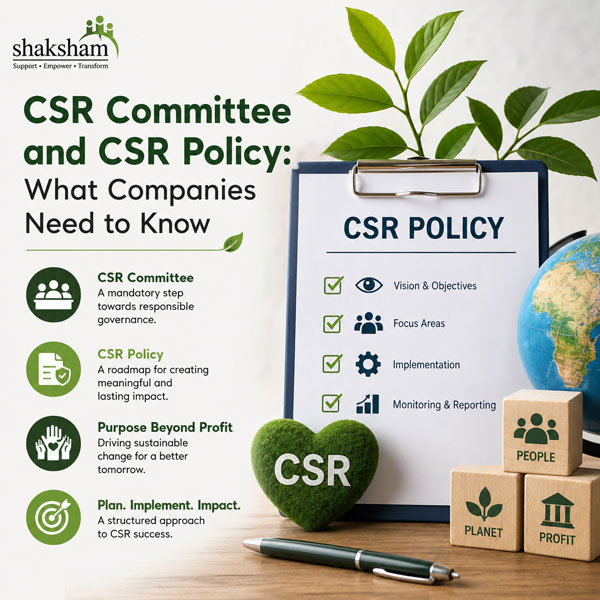
CSR Committee and CSR Policy: What Companies Need to Know
For companies covered under Section 135 of the Companies Act, establishing a structured CSR framework is just as important as spending the required amount. A well-defined CSR policy helps companies identify suitable projects, allocate funds responsibly, and measure the impact of every initiative.
The Board of Directors plays a key role in overseeing CSR activities. Depending on the company’s legal requirements, a CSR Committee may also be constituted to recommend projects, monitor implementation, and review progress throughout the financial year.
A comprehensive CSR policy generally includes:
- The company’s CSR vision and objectives.
- Approved focus areas under Schedule VII.
- The annual CSR budget and allocation process.
- Project implementation methods.
- Monitoring and reporting mechanisms.
- Impact assessment wherever applicable.
Companies that follow a structured approach are often able to create stronger social outcomes while maintaining complete compliance with statutory requirements.
Can Companies Implement CSR Through NGOs?
Yes. Many companies choose to implement CSR projects through registered NGOs instead of managing programmes internally. This approach allows businesses to work with organisations that already have experience, local knowledge, and established community networks.
An experienced implementation partner can manage project execution, beneficiary identification, documentation, monitoring, and reporting, allowing companies to focus on governance and compliance.
For organisations planning long-term CSR initiatives in Gujarat, Shaksham Foundation’s CSR partnership programme supports projects in education, orphan care, healthcare, food assistance, environmental conservation, women’s welfare, and senior citizen support.
Who Can Receive CSR Funds?
An implementing agency should satisfy the eligibility requirements prescribed under the Companies (Corporate Social Responsibility Policy) Rules.
Generally, the organisation should:
- Be registered as a Trust, Society, or Section 8 Company.
- Be registered by filing Form CSR-1 with the Ministry of Corporate Affairs.
- Possess valid 12A and 80G registrations under the Income Tax Act.
- Maintain proper financial records and audited accounts.
- Have transparent governance and project documentation.
- Demonstrate experience in implementing social development projects.
The Government provides detailed compliance guidelines through the Ministry of Corporate Affairs.
How to Choose the Right CSR Implementation Partner
Selecting the right NGO can significantly improve the success of a CSR programme. While legal compliance is important, companies should also evaluate an organisation’s ability to deliver measurable and sustainable outcomes.
Before entering into a partnership, consider the following factors:
- Verify all statutory registrations and certifications.
- Review previous CSR projects and their measurable impact.
- Check financial transparency and audit reports.
- Assess the organisation’s reporting and documentation process.
- Ensure the proposed projects fall under Schedule VII.
- Discuss project timelines, milestones, and expected outcomes before implementation.
A transparent partnership benefits both the company and the communities receiving support.
Why Many Companies Choose Shaksham Foundation for CSR Projects
Successful CSR programmes require more than financial support. They require careful planning, regular monitoring, transparent reporting, and meaningful engagement with local communities. This is where an experienced implementation partner makes a significant difference.
Shaksham Foundation works across Ahmedabad and Gujarat with programmes that align closely with the approved activities listed under Schedule VII of the Companies Act.
Some of the key focus areas include:
- Education support for children from financially disadvantaged families.
- Care and support for orphaned children.
- Healthcare and medical assistance programmes.
- Food distribution and nutrition initiatives.
- Women’s welfare and livelihood support.
- Environmental awareness and conservation projects.
- Support programmes for senior citizens.
Companies looking to invest in education-based CSR projects can also learn more about the Foundation’s Education Support Programme, which focuses on improving access to learning resources and creating better educational opportunities for children.
By partnering with an organisation that has strong community connections and transparent project management, businesses can create long-term value while fulfilling their CSR obligations responsibly.
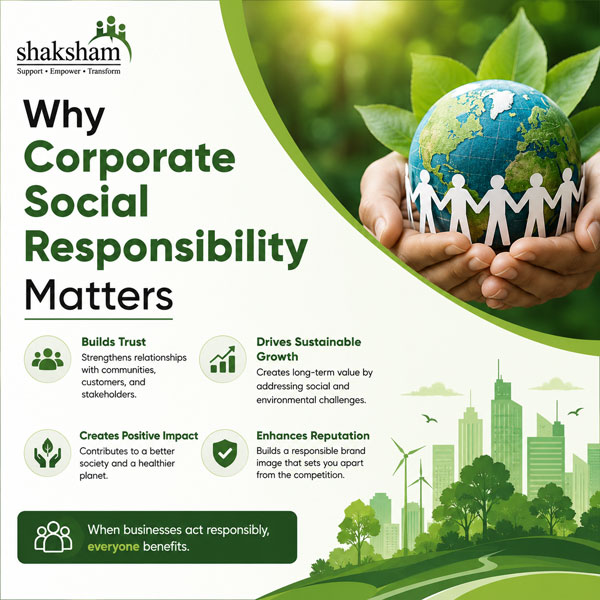
Why Corporate Social Responsibility Matters
Corporate Social Responsibility is no longer viewed as just a compliance requirement. When planned carefully, it helps businesses create measurable social impact while strengthening their reputation, stakeholder confidence, and long-term business sustainability.
Companies that invest in well-executed CSR initiatives often build stronger relationships with local communities, improve employee engagement, and demonstrate responsible corporate governance. These factors also contribute positively to Environmental, Social and Governance (ESG) performance, which has become increasingly important for investors and business partners.
Some of the key benefits of Corporate Social Responsibility in India include:
- Improves brand reputation and public trust.
- Supports long-term community development.
- Strengthens ESG performance and sustainability goals.
- Enhances employee participation through volunteering initiatives.
- Builds stronger relationships with stakeholders and local communities.
- Helps companies meet statutory CSR obligations efficiently.
- Creates measurable social impact through structured development programmes.
Rather than treating CSR as an annual obligation, many organisations now integrate it into their long-term business strategy to create sustainable value for both society and the company.
Penalties for Non-Compliance with CSR Provisions
Failure to comply with CSR requirements under the Companies Act, 2013 may result in financial penalties. Companies are also required to provide appropriate disclosures regarding CSR expenditure and explain any unspent amounts in accordance with the applicable provisions of the Act.
| Non-Compliance | Possible Consequence |
|---|---|
| Failure to transfer unspent CSR amount as required | Financial penalties under the Companies Act, 2013. |
| Failure to comply with CSR reporting requirements | Penalties may apply to both the company and responsible officers. |
| Improper utilisation or reporting of CSR funds | Regulatory scrutiny and possible legal action. |
Besides legal consequences, non-compliance can also affect a company’s credibility, investor confidence, and corporate reputation. Detailed compliance requirements are available on the Ministry of Corporate Affairs website.
The Future of Corporate Social Responsibility in India
CSR in India continues to evolve as businesses move beyond one-time donations and focus on long-term development programmes. Companies increasingly prefer projects that produce measurable outcomes, transparent reporting, and sustainable community development.
Education, healthcare, environmental conservation, livelihood generation, child welfare, and skill development remain among the most preferred CSR sectors. Many organisations are also investing in digital education, renewable energy, sanitation, and rural development projects to maximise long-term impact.
Working with experienced implementation partners allows companies to execute these initiatives efficiently while maintaining proper documentation and regulatory compliance.
Partner with Shaksham Foundation for Meaningful CSR Projects
If your organisation is looking for a reliable CSR implementation partner in Ahmedabad or Gujarat, Shaksham Foundation offers professionally managed programmes that align with Schedule VII of the Companies Act, 2013.
The Foundation works across several focus areas, including:
- Education support for children.
- Orphan care and child welfare initiatives.
- Healthcare and medical assistance.
- Women’s welfare programmes.
- Food support initiatives.
- Environmental conservation activities.
- Senior citizen support programmes.
Companies interested in improving educational opportunities through CSR can explore the Foundation’s Education Support Programme. Businesses seeking end-to-end CSR implementation can also learn more about CSR partnership opportunities with Shaksham Foundation.
Every CSR project is designed with transparency, accountability, and measurable outcomes in mind, helping companies fulfil their statutory obligations while creating meaningful social impact.
Frequently Asked Questions
Is Corporate Social Responsibility mandatory in India?
Yes. CSR is mandatory for companies that meet any of the financial thresholds prescribed under Section 135 of the Companies Act, 2013.
How much should eligible companies spend on CSR?
Eligible companies are required to spend at least 2% of their average net profits from the previous three financial years on approved CSR activities.
Can CSR funds be given to an NGO?
Yes. Companies can implement CSR projects through eligible NGOs that satisfy the requirements prescribed under the Companies (Corporate Social Responsibility Policy) Rules.
What types of activities qualify for CSR?
Approved activities include education, healthcare, environmental sustainability, rural development, women’s welfare, child welfare, livelihood enhancement, disaster relief, sanitation, and several other areas listed under Schedule VII of the Companies Act.
Why should companies partner with Shaksham Foundation?
Shaksham Foundation implements projects that align with Schedule VII while maintaining transparency, proper documentation, and measurable outcomes. This enables companies to fulfil their CSR responsibilities through structured community development programmes.
Conclusion
Corporate Social Responsibility in India has become an essential part of responsible business operations. While compliance with the Companies Act, 2013 is important, the true value of CSR lies in creating lasting social impact through carefully planned and well-executed projects.
Choosing the right implementation partner can make a significant difference. With programmes focused on education, healthcare, orphan care, food assistance, women’s welfare, environmental conservation, and senior citizen support, Shaksham Foundation helps companies transform CSR commitments into meaningful action.
If your organisation is planning its next CSR initiative, explore the Foundation’s Corporate Social Responsibility programme or learn more about its Education Support initiatives to build projects that create measurable and lasting results.

Related Posts



Comments (0)